Crypto Mining Explained: How Transactions Get Verified
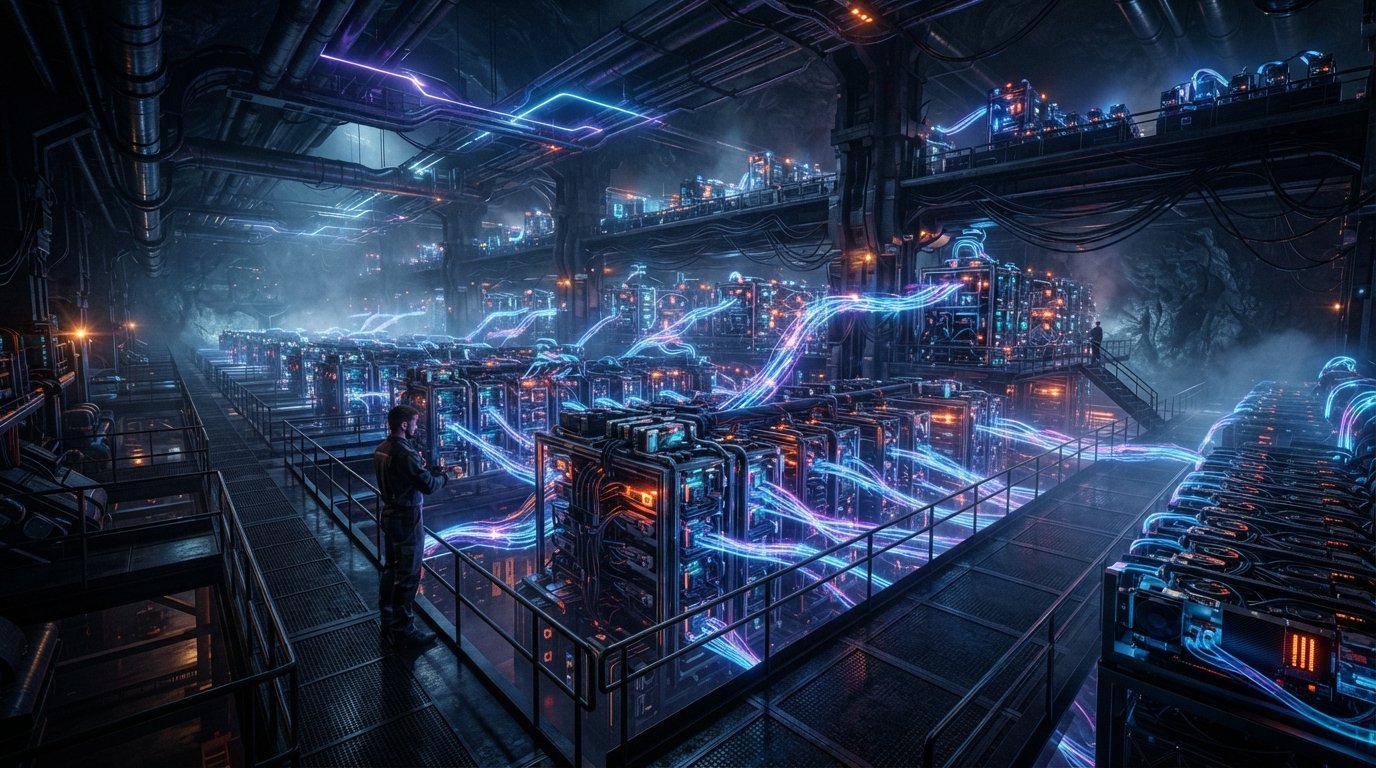
Crypto mining is the process by which proof-of-work blockchains like Bitcoin verify transactions and mint new coins. Miners race to solve a cryptographic puzzle using powerful computers; the winner validates a block of pending transactions, adds it to the blockchain, and earns newly created coins plus fees. The competition is hard by design so that nobody can control the ledger, and its energy cost is what makes rewriting history economically impossible.
What Is Crypto Mining?
When people hear “crypto mining,” many picture pickaxes and gold pans  an image that does a surprising amount of justice to the economics involved. Just as gold miners expend real resources to dig up something scarce, crypto miners expend real computing power and electricity to earn newly created coins. The “minerals” being unearthed are block rewards, and the “machinery” is specialized computer hardware.
Cryptocurrency mining is the process where computers  called miners  compete to verify groups of pending transactions (blocks), add them to the blockchain, and in return receive newly minted coins and transaction fees. Mining exists on proof-of-work (PoW) networks, the most famous being Bitcoin. It performs two indispensable jobs simultaneously:
- Verification and settlement: Mining confirms that transactions are legitimate and permanently records them on the public ledger.
- Coin issuance: Mining is the only way new bitcoins are brought into circulation  there is no central mint stamping them out.
If you are new to the fundamentals behind this, our guide What Is Cryptocurrency and How Does It Work? will bring you up to speed on blockchains and why a decentralized network needs a verification mechanism at all.
The Problem Mining Solves: Double Spending
The entire invention of Bitcoin can be framed as the solution to one infuriating puzzle: how do you prevent the same digital money from being spent twice?
Ordinary money has a physical form  you cannot hand the same ten-dollar bill to two people, because you only have one bill. Digital money is different. A digital file is infinitely copyable. Without a central bank to check a ledger, a dishonest user could simply make two transfers with the same balance: send 1 BTC to Alice, then send the same 1 BTC to Bob. Which transfer is “real”?
Early digital-cash systems (DigiCash, e-gold) solved this by keeping a central authority that tracked balances. Bitcoin set out to do it without any authority  a problem cryptographers had been struggling with for decades, known in technical circles as the Byzantine Generals’ Problem (how to get untrustworthy parties to reach trustworthy agreement).
Proof of work is the answer Satoshi Nakamoto chose. The network’s rule is blunt and elegant: the authoritative history of transactions is the one that required the most computing work to produce. Because every block is chained to the one before it, and because recreating that history would require redoing the work of every subsequent block, an attacker cannot quietly rewrite the past  the cost is simply too high. Mining turns the double-spending problem from a trust problem into a physics-and-economics problem.
How Proof of Work Works
Proof of work is a contest with a specific, verifiable goal. Here is the mechanism without the math:
- Block assembly. Pending, valid transactions are gathered from the network’s mempool into a candidate block containing a timestamp, a reference to the previous block, and the transactions.
- The puzzle. Each miner adds a random field called a nonce (a number used once) and feeds the whole block into a hash function  a mathematical operation that turns any data into a fixed-length fingerprint (more on hashes in the next section).
- The target. Bitcoin requires the resulting hash to start with a specific number of zeros  for example, “000000…”. The required number of leading zeros sets the difficulty.
- The race. Miners try nonce after nonce  literally trillions of times per second  until one of them produces a hash meeting the target. This is pure brute force; there is no shortcut or smarter strategy.
- Proof and propagation. The winning miner broadcasts the block with its valid hash. Every other node instantly verifies the hash (~a millisecond of work) and, if valid, adds the block to their copy of the chain.
- The reward. The winner collects the block reward (newly minted coins) plus the transaction fees included in the block.
The brilliance is in the asymmetry: producing a valid block is enormously expensive (the proof of work), but verifying it costs almost nothing. Anyone can check that a hash meets the target, so the network can agree on the winner in milliseconds. Difficulty automatically adjusts so that, regardless of how much computing power exists, a new block is found roughly every 10 minutes.
Hashes Explained in Plain English
Hashes are the heart of mining, and they are much easier to grasp than the jargon suggests.
A hash function is a machine that takes any amount of input  a word, a book, or a block of transactions  and squeezes it into a fixed-length string of letters and numbers, called a digest. Bitcoin uses a function called SHA-256, which always produces a 64-character hexadecimal digest. Three properties make hashes the perfect building block for mining:
- Deterministic: The same input always produces the same output.
- Avalanche effect: Change a single character in the input and the output changes completely  unpredictably. There is no pattern to exploit.
- One-way: You cannot reverse a hash to recover the input. Given a digest, the only way to find an input that produces it is to guess (which is precisely what mining does).
This is why mining is described as a lottery by brute force: miners are essentially rolling a giant, astronomically-sided die billions of times per second, looking for the rare roll that produces a hash starting with the required zeros. Because the result is unpredictable, the system is fair  nobody can aim for the winning hash; they can only try more attempts than everyone else.
How a Transaction Gets Verified, Step by Step
Now we can stitch everything together. Here is the complete life of a Bitcoin transaction, from click to confirmation  the canonical example of how mining verifies transactions:
- Alice signs a transaction. Using her private key, she signs a message paying Bob. The signature proves she owns the coins without revealing her key. (Wallet mechanics are covered in How Crypto Wallets Work.)
- The transaction is broadcast. Alice’s wallet sends the signed transaction to the peer-to-peer network. It spreads to thousands of nodes within seconds.
- Nodes validate it. Every full node checks three things: Is the signature valid? Does Alice have the balance? Has this coin already been spent? Invalid transactions are dropped here, before they ever reach a miner.
- The transaction enters the mempool. Valid transactions wait in a shared pool of unconfirmed transactions. Miners select which ones to include, generally prioritizing higher fees because they earn those fees directly.
- A miner builds a candidate block. The chosen transactions are packaged with a timestamp and the hash of the previous block.
- The miner races to find a valid hash. Trillions of guesses per second, hunting for a nonce that makes the block hash meet the difficulty target. On average this takes the entire network ten minutes.
- The block is broadcast and verified. The winning miner shares the block; all nodes check the hash in milliseconds and add the block to their chains. Alice’s transaction now has 1 confirmation.
- Confirmations accumulate. Each subsequent block adds another confirmation. Most exchanges require 2–6 confirmations before crediting deposits; the chance of a deep reorganization falls exponentially with every block.
Notice the crucial detail: mining does not “approve” transactions in the sense of trusting anyone. It orders already-validated transactions into an immutable, consensus-backed timeline. The network decides when Alice’s payment happened and makes that decision extremely expensive to reverse.
Block Rewards and the Halving
Miners are paid in two forms: the block subsidy (brand-new bitcoins created out of thin air) and transaction fees (what senders pay to prioritize inclusion). Together these make up the security budget of the network  the financial incentive that keeps miners racing honestly.
Bitcoin’s supply schedule is one of the most audited pieces of code in existence. The block subsidy started at 50 BTC per block in 2009 and is cut in half every 210,000 blocks  roughly every four years  in an event known as the halving. The past halvings tell the story:
| Halving event | Year | Block subsidy |
|---|---|---|
| Genesis → first halving | 2009–2012 | 50 BTC |
| 1st halving | 2012 | 25 BTC |
| 2nd halving | 2016 | 12.5 BTC |
| 3rd halving | 2020 | 6.25 BTC |
| 4th halving | 2024 | 3.125 BTC |
| 5th halving | 2028 (expected) | 1.5625 BTC |
Source: Bitcoin protocol rules; schedules are fixed in code.
The schedule means new supply steadily shrinks toward zero: the total is capped at 21 million bitcoins, with the last coin expected around the year 2140. As the subsidy shrinks, transaction fees must eventually grow to sustain mining  a long-term design question the community continues to debate. Historically, halvings have also been associated with big price cycles, because they halve the flow of new supply into the market, though past performance never guarantees future outcomes.
Mining Hardware: From CPUs to ASICs
The hardware arms race is one of mining’s defining stories. Each generation represented a step-change in efficiency:
- CPU era (2009–2010): In the beginning, anyone could mine Bitcoin on a normal laptop’s CPU. A few enthusiasts early-mined what are now fortunes.
- GPU era (2010–2013): Graphics cards proved far faster at the parallel work mining requires. Graphics processing units (GPUs)  the same chips gamers use  took over.
- FPGA and first ASICs (2011–2013): Field-programmable gate arrays transitioned into dedicated hardware, and then the first ASICs (Application-Specific Integrated Circuits) arrived. An ASIC is a chip designed to do exactly one thing: compute SHA-256 hashes as fast as possible.
- Industrial era (2014–present): Mining migrated to warehouses full of ASICs, often called mining farms, frequently co-located near cheap electricity. At the web’s own scale, the global Bitcoin network now computes in the hundreds of exahashes per second.
This progression is why “I can just mine some Bitcoin on my PC” is a myth today. ASICs are thousands of times more efficient than any general-purpose computer. Unless you have free electricity and serious capital, Bitcoin mining is a losing game  a point the profitability section will make concrete.
Mining Pools and How They Work
Solo mining has a lottery problem: with industrial competition, a single miner’s chance of finding a block is minuscule, meaning they might work for months or years and earn nothing at all. Mining pools fix this by combining the computing power of many miners and sharing the rewards.
Here is how a pool works:
- Members pool their hash power. Individual miners connect their machines to the pool’s server and contribute work toward blocks the pool builds.
- The pool finds blocks. When the combined power wins a block, the reward is credited to the pool.
- Rewards are split by contribution. Each miner is paid proportionally to the work they contributed (usually measured by shares), minus a small pool fee. This turns an unpredictable lottery into a steady, predictable income stream proportional to hashrate share.
Pools bring their own trade-offs. The most important is centralization risk: if a handful of pools control most of the network’s hashrate, they approach the threshold required to coordinate attacks or censorship. This is why the largest pools are constantly scrutinized, and why protocols enforce limits on how many blocks any single pool should win. For the individual miner, pools are effectively the only rational way to mine Bitcoin today  but they are also the reason some purists worry about Bitcoin’s decentralization over the long run.
| Factor | Solo mining | Pool mining |
|---|---|---|
| Income | Lumpy  all-or-nothing lottery | Steady  proportional to your hashrate |
| Entry barrier | Very high hardware + electricity needs | Lower  pool handles block strategy |
| Control | Full  no middleman | Pool operator selects transactions and sets fees |
| Fees | None | Typical pool fee 0–2% of rewards |
Is Mining Still Profitable?
The honest answer for almost everyone in 2026 is no  not at home, not at retail scale. Profitability now follows the rules of industrial infrastructure:
- Electricity is everything. The margin between profit and loss is dominated by the price of power. Commercial miners negotiate $0.03–$0.06/kWh (or use stranded and renewable energy), rates a household can rarely match.
- Hardware depreciates fast. ASICs become obsolete quickly as difficulty rises, and each generation of machines makes the previous one unprofitable. The write-down can wipe out paper gains.
- Difficulty tracks price expectations. When Bitcoin rises, more miners join, difficulty climbs, and per-hash earnings fall. The system self-corrects to keep block times at 10 minutes  which means your slice of the pie keeps shrinking.
- Set-up and maintenance cost money. Heat, cooling, repair, pool fees, and the time of a competent engineer are all real costs.
The standard way to model any mining decision is the breakeven calculation: expected daily earnings from a hash calculator, minus electricity cost, minus hardware amortization. Ethereum’s move to proof of stake in 2022 took GPUs out of the mining economy overnight, leaving Bitcoin ASIC operations (and a few other PoW chains) as the only industrial game in town.
Rule of thumb: if your electricity costs over ~$0.12/kWh and you are not mining at industrial scale, you are very likely subsidizing the network, not earning from it.
The Energy and Environmental Debate
No discussion of mining is complete without the elephant in the room: electricity. Bitcoin mining consumes energy comparable to small countries, a fact that fuels both fierce criticism and fierce defense. The truth is more nuanced than either extreme suggests.
The critics’ case: Proof of work burns electricity for no productive output. Every transaction subsidizes an enormous, persistent energy load, and putting a price tag on mere accounting is wasteful when far more efficient alternatives exist. Even if the share from renewables grows, absolute consumption continues to rise as price and difficulty climb.
The defenders’ case: The energy is not wasted  it is the security budget that makes a censorship-resistant, settlement-grade money possible without a central issuer. Moreover, mining disproportionally uses stranded energy (hydro, solar, and gas that would otherwise be wasted or flared), and several studies estimate Bitcoin mining speeds up the build-out of renewable capacity by serving as a flexible buyer. Mining can also locate anywhere, unlike a bank headquarters, and it monetizes electricity that has no other buyer.
Where the truth lands: both narratives contain real evidence. What is beyond dispute is that proof of stake (PoS) achieves comparable security with roughly 99%+ less energy  which is exactly why Ethereum abandoned mining, and why the broader industry is steadily moving away from PoW despite its historic importance. For a detailed look at that alternative, read What Is Crypto Staking and How Does It Work Today?
Is Mining Legal? Regulation by Region
Mining’s legal status varies dramatically around the world and changes quickly. As of 2026, the landscape looks roughly like this:
- United States: Legal, though electricity prices, local permitting, and federal policy debates create regional differences. Texas has courted miners for grid flexibility.
- European Union: Legal and increasingly regulated. The Markets in Crypto-Assets (MiCA) framework governs the sector, and energy-reporting requirements for large miners are being phased in under sustainability rules.
- China: Illegal  mining was banned in 2021. Network hashrate redistributed to Kazakhstan, the US, Russia, and elsewhere.
- El Salvador: A notable adopter, even mining with geothermal energy from volcanoes since 2021.
- Other jurisdictions: Iran and Russia have both banned and courted mining depending on grid pressure; several African and Latin American countries are experimenting with stranded-energy mining sites.
If you are considering mining, verify the rules in your jurisdiction first  some regions require licenses, and a ban can strand expensive hardware overnight. Regulation is evolving, and mining’s energy profile keeps it squarely in the crosshairs of policymakers.
Proof of Stake: The Alternative to Mining
Mining is one answer to the consensus problem. Since 2012, a second answer  proof of stake  has risen to dominance, and today more major chains run on it than on mining.
Where mining spends electricity, proof of stake locks up capital. Validators deposit the network’s native coin as collateral; the protocol randomly selects among them to propose and confirm blocks; honest validators earn rewards, while dishonest ones are financially punished (“slashed”). The security logic is identical in spirit  an attacker would need to control a majority of the network’s economic stake  but the physical footprint is a fraction of mining’s.
The comparison in one table:
| Factor | Proof of Work (mining) | Proof of Stake (staking) |
|---|---|---|
| Resource spent | Electricity + hardware | Capital (coins) |
| Security assumption | Control of 51%+ hashrate | Control of 33–50%+ of staked coins |
| Energy use | Very high | ~99%+ lower |
| Entry for individuals | Expensive ASICs, industrial power | Pools allow small amounts |
| Main networks | Bitcoin, Litecoin, Dogecoin | Ethereum, Solana, Cardano |
This is why our guide to crypto staking is essential reading for anyone who has learned the basics of mining: the industry’s center of gravity has decisively shifted toward staking, and most new networks are designed as proof of stake from day one. Mining’s enduring relevance comes down to Bitcoin’s dominance and the unique security narrative of “digital gold.”
Frequently Asked Questions About Crypto Mining
Q Is crypto mining legal? +
It depends on your country. Mining is legal in the US, EU, and many other nations, illegal in China, and heavily regulated or restricted in others such as parts of Russia and Iran. Laws change quickly and some regions require licenses. Always verify the rules in your jurisdiction before setting up mining hardware.
Q How long does it take to mine 1 Bitcoin? +
One Bitcoin block (3.125 BTC as of the 2024 halving) is found every ~10 minutes by the whole network. An individual miner’s expected time to earn 1 BTC depends entirely on their share of total network hashrate. A household ASIC might earn a tiny fraction of a bitcoin per month  for most miners, the practical answer is “years,” and solo mining is usually a lottery.
Q Do I need a powerful computer to mine crypto? +
For Bitcoin, yes  you need specialized ASIC hardware; regular computers cannot compete. For some smaller proof-of-work coins, GPU or even CPU mining is still possible but rarely profitable. If your goal is simply earning passive rewards, staking or exchange products are far more accessible than mining.
Q Is mining profitable? +
For most individuals in 2026, no. Profitability depends on electricity cost, hardware efficiency, difficulty, and Bitcoin’s price. Commercial operations with sub-$0.06/kWh power can still profit; households paying typical rates usually lose money once hardware depreciation is counted. Run a mining profitability calculator with your real electricity price before investing anything.
Q Can I mine crypto on my home computer? +
Technically yes for some small coins, but practically no for Bitcoin  ASICs outclass any home PC by orders of magnitude, and electricity bills will exceed earnings. Home mining also creates heat, noise, and wear on hardware. Consider staking instead for a realistic passive-income approach.
Q Is Bitcoin mining bad for the environment? +
Bitcoin mining uses significant electricity  comparable to the annual consumption of a medium-sized country  and this is a genuine concern. However, a large and growing share of mining uses renewable or stranded energy, and some argue it accelerates renewable build-out. Proof-of-stake alternatives like Ethereum use over 99% less energy, which is why the industry is migrating away from mining.
Conclusion: The Engine Behind Digital Gold
Crypto mining is frequently caricatured as pointless computing that wastes electricity. Looked at more carefully, it is one of the most elegant incentive systems ever designed: a way for thousands of strangers to maintain a single, trustworthy ledger with no central authority, where the cost of cheating is deliberately astronomical.
Understanding mining matters even if you never plug in a miner, because it explains Bitcoin’s entire economic design  its fixed supply, its halvings, its energy profile, and the reason its ledger has never been successfully rewritten in nearly two decades. It also frames the great industry debate of our time: the trade-off between proof-of-work’s proven security and proof-of-stake’s dramatically lower footprint.
If you take one practical lesson away, let it be this: mining is infrastructure, not a hobby. For individuals, the far more realistic route to earning crypto is staking or exchange products  and the security foundation for any of it is a properly managed wallet.
Deepen your understanding with these related Coyyn guides:
- What Is Cryptocurrency and How Does It Work?  the fundamentals.
- What Is Crypto Staking and How Does It Work Today?  the energy-efficient alternative.
- Bitcoin vs Ethereum: Key Differences You Should Know  why only PoW chains get mined.
- How Crypto Wallets Work and How to Keep Them Safe  secure storage before you participate.
- Browse all Cryptocurrency articles  return to the category hub.